The Rainbow People
PUERTO RICANS: THOROUGHBREDS OR MUTTS?
 by
Izzy Zanabria
by
Izzy Zanabria
History has taught us that
conquerors plundered, raped, killed and destroyed cultures.
As conquerors go, the Spaniards were one of the worst and at
the same one of the best. They practiced slavery and
instituted racism, but unlike the Americans, they were more
tolerant of the Indian and African cultures, and even merged
with them. And in so doing, created a whole new culture.
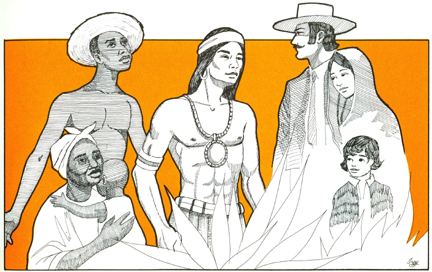
As a consequence of the Indian rebellions in Puerto Rico,
there is still a very strong strand of Indian genetics
present in the island’s racial make-up. There’s European
(white, blue-eyed blondes), African (Blacks) and Indian, as
well as an overlapping of each. Whereas in Cuba and Santo
Domingo, where the Indians were literally wiped out, the
population is basically either black or white, and their
mixture, Mulattos.
The Spaniards first instituted these racial mixtures, then
clearly defined/categorized each group by name, (i.e.) white
with Indian- Creoles, Indian and black-Mestizos, etc.
However, unlike American and other European slave owners or
traders, when the Spaniards fostered children, they also
gave them their last names. Of greater importance, they also
married the women (due to honor and the strong influence of
the Catholic Church).
Another interesting facet of Spain’s racism which differs
from American, is their relationship with the blacks and
Indians. In America, Blacks were used to fight Indians, The
Blacks were led to believe that they were less savage, and
even part of the new system, etc. Such policies made the
Indians the worse treated group in America.
In Puerto Rico, there was a great deal more homogenization
which gave birth to what is today’s island culture. The
Spanish influence is of course most prominent. They set the
social standards, religion and language. And ironically,
though born American citizens (since 1907), the Puerto Rican
people continue to vote Spanish as its national language.
English is however, a required second language in the
schools.

Nowhere is the fusion of the
three cultures more evident, than in the music. And where
the biggest African influence on the culture is evident. In
Cuba, Puerto Rico and The Dominican Republic, the basis for
much of its folklore and popular dance music are the African
Rhythms. The music is a mixture of Indian and African
percussion with Spanish lyrics and melodies. Another
interesting irony is that those Caribbean islands are
reponsible for keeping the African rhythms and culture alive
in this hemisphere. American blacks were deprived of any
ties with their African culture. Many years later, black
Jazz musicians were exposed to these rhythms and of course
immediately took to them like ducks to water and
incorporated them into Jazz. It was the doing of Dizzy
Gillespie with Cuban percussionist Chano Pozo that recorded
a number “Manteca” that started the new musical art form of
Latin-Jazz.
While America’s racism considered a person “a Negro” if they
had any drop of black blood, in Puerto Rico, it was more a
matter of skin tone and perhaps passing as white. Being
lighter, often meant better education, etc. In essence,
looking more like Spaniards. In fact in Puerto Rico there’s
a saying that tells it all.
“BEING WHITE, IS A CAREER, LIKE ANY OTHER CAREER! Therefore,
Criollos were supposedly better than Mestizos, etc. Another
method of separation (or acceptance) was based on hair.
Straight hair being good and kinky bad. Therefore, a dark
skinned person with straight hair might be considered white.
The common denominator has always been the Hispanic culture.
As a consequence, Caribbean blacks have always felt superior
to American blacks with the argument, “I’m Spanish”! And
they felt justified since they in fact had a sense of
history and a culture—Spanish or African. The American only
had slavery as a reference point. That is, until Haley wrote
the book, “Roots” which was made into a successful
television movie.
Because the Spaniards married the women in the Catholic
church, they also instituted and culturally emphasized the
importance of the family unit. Again something American
blacks were deprived of, since slave owners systematically
broke up families by selling them off separately.
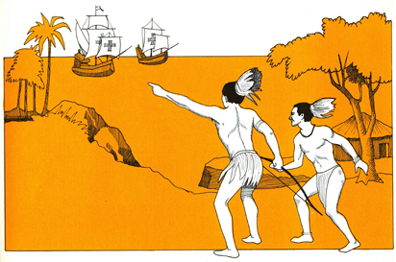
Puerto Rico did win a short
lived independence from Spain, but came under American rule
after the Spanish-American war. And this by the way, is why
many Puerto Ricans hold resentments toward the United
States, especially among the advocates of Independence.
Spain’s greatest gift or contribution to Puerto Rico was the
creation of “The Rainbow People”. A people and culture Not
made up of human mutts of casual inter-racial sexual
encounters, but rather blessed with inheriting the blood and
cultures of three of the world’s great races. In an ironic
sense, if the world ever learns to live in peace, harmony,
free of racism and inter-marry, eventually the whole world
will look like Puerto Ricans.
Imagine a future world, where the average person is
genetically comprised of all God’s children. And then
perhaps one day they’ll all be standing together, ready to
greet visiting aliens from another world as true Earthlings.
So ironically, wherever the world is going, perhaps Puerto
Ricans have already started the ball rolling.
TEXT & ARTWORK
COPYRIGHT © 2001 • BY IZZY SANABRIA -
SalsaIzzy@gmail.com Tel: 813
684-1518

¡Ooooye!


 GO
BACK
GO
BACK