Today is...
As an amateur historian, I have no intention of re-writing
history... so please abstain from shooting in this direction
if you happen to disagree with me. I just want to, if you'll
allow me, add a little bit more of light unto the data we
already have. Remember... "a picture is worth a thousand
words." Therefore, memory is worth having, especially for those
of us who weren't there. If you travel to some areas in Puerto Rico, you might
be able to see some traces of all those years ago. Everything was simple,
significant and impacting. Your Grandma told you about those times. ¿Didn't she?
Thanks to Jack Delano and the
remarkably written "Cinco Siglos de Historia"
(McGraw-Hill) by Fajardo's own Francisco Scarano of the
University of Wisconsin at Madison. Also thanks to the
great photographer Tom Lehman

Jibaro walks past the national Flamboyán Tree beyond his
"casita.


It may be unusual for a little gir to have a pet-pig but not
in the 1940s


A Puerto Rican Plaza (town square) is an open public space
found in the heart of a traditional town used for community
gatherings. Most town plazas are hardscapes suitable for
open markets, music concerts, political rallies, and other
events that require firm ground. Being centrally located,
they are usually surrounded by small shops such as bakeries,
meat markets, cheese stores, and clothing stores. At their
center is often a fountain, well, monument, or statue.
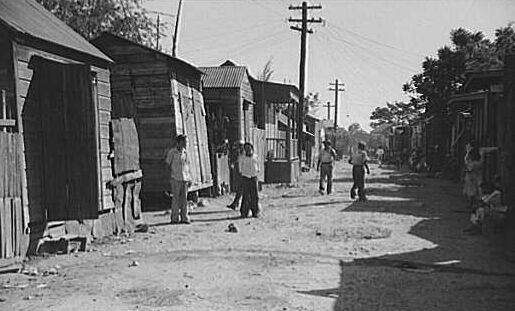
Barrio Machuelito, Ponce PR 192 ---
The apparent poverty was because PR depended in the
agricultural economy, whose profits didn't stay within the
Island, as many of the companies were owned for foreign
investors.

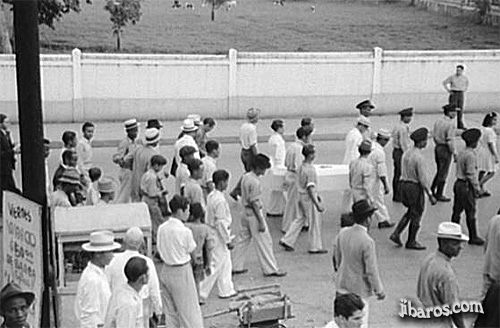
When I was a kid in the 50s, street funerals were common. Hearses were used by the wealthy. People walked all the way from the Funeral Home to the cemetery, men often taking turns carrying the coffin. This one is a smaller casket, probably a young person.
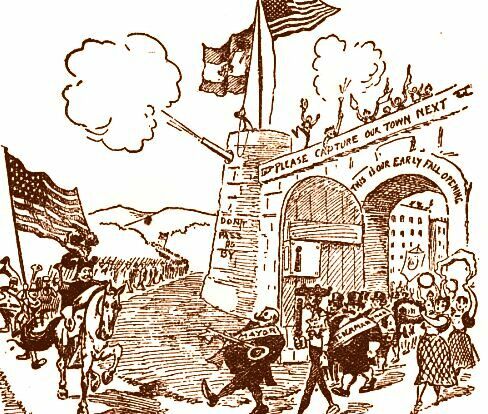
This political cartoon, published in 1898, shows a cynical
but not inaccurate view of how Puerto Ricans received the "invader" USA. The great Puerto Rican historian Francisco Scarano, comments on how joyous was the reception by the many
local communities... "with cordial enthusiasm that verged into
carnival-like happiness... what the mayor of Yauco called 'a
miracle intervention by the God of the just'."
Bowling (Bolera) c.1900
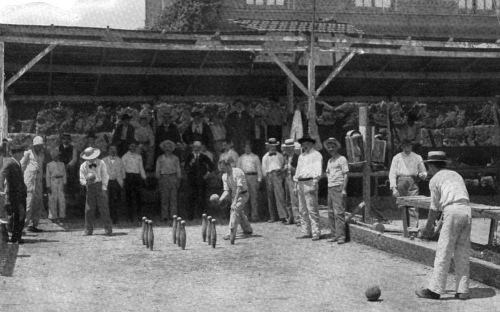
Boricuas were sophisticated enough to go bowling
in the outskirts of San Juan. Notice that the pins are
thinner are arranged differently. Also, the ball is smaller.
The Foraker Act of 1900 hads instituted USA government
officially
in Puerto Rico. Community life changed dramatically and
unexpectedly.
The
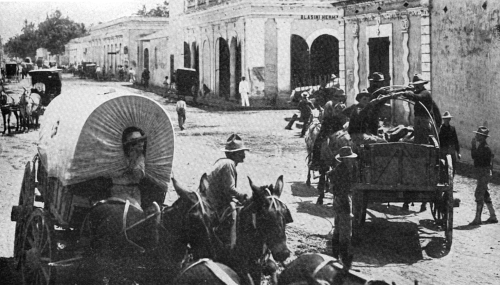
U.S.A. Invasion
This photo depicts the US troops after landing in Ponce, in
what the newspapers call "a picnic war". From the casualties
inflicted to both sides, about 157, only a small number
(less than 20%) were by actual combat. Many deaths were
attributed to lack of medical attention due to diseases
acquired during the course of the relatively short war.
One of the main "lamentos borincanos"
(boricua laments) was the legality of the invasion; "ilegal" because
Spain had already granted PRs a "partial autonomy" in the "Carta
Autonómica del 25 de Noviembre del 1897"... That autonomy
had drafted ideas and socio-political reforms which never
came to pass because "somebody" sank the American ship, the
USS Maine in Havana, Cuba... triggering thus the conflict.
HOWDAYALIKEDAT?
Even though
the US had placed a naval blockade a few weeks earlier, there was no
shooting until May 12, 1898... when Adm. William Sampson blessed the
southern part of Puerto Rico with a rain of torpedoes that would
last only three hours.
So there you have it, folks... a "titingó" that we
called the Spanish American War (Guerra
Hispano-Americana) blew up on April 21 of 1898. However, in
the Treaty of Paris eight months later (Dec. 10), United
States would pay Spain $20 million dollars as
indemnification, ergo... money paid in compensation for
loss of the Philippines, Cuba and Puerto Rico! Nice, huh?
San
Juan City Hall and Plaza de Armas, 1941
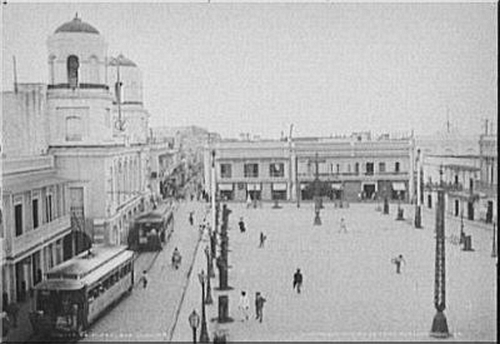
After
the Great Depression of 1929, being a territory of the USA for for
over 30 years, Puerto Rico suffered as much, if not more than other
states in the mainland. The local economy depended on American
stability. Inferred by the photo above, Boricuas are transitioning from a basically agricultural
economy to an industrial one; one that will eventually will support
the partial autonomy obtained in later years. The ubiquitous 5&10
cent store (5-10-25¢) on the right will mold a pattern to be emulated by small merchants in almost all towns
throughout the Island. The San Juan City Hall is on the left
serving as a stop for the Trolley cars

donjibaro@gmail.com
This is the bottom line
“Live in such a way that no one blames the rest of us
nor finds fault with our work.” —(2 Corinthians 6:3)

Jibaros.Com®,
Jibaros.Net® - ALL content is Copyright © by Orlando Vázquez,
owner-designer and com does not accept any responsibility for the
privacy policy of third party sites