Political and Cultural History
Arturo Morales Carrion
Grammy Nominated
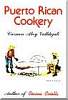
A Taste of Puerto Rico
Cook Book by Yvonne Ortiz
Puerto Rico : A Political and Cultural History
by Arturo Morales Carrion
Grammy Nominated
Always refer, in pitying,
sympathetic tones,
to "Liberal psychopathology." ►
BUY EYE-OPENER BOOK HERE◄
Holes In The English
Tongue Dept
How to Speak Americano by Don Jibaro
To be understood in the USA of the 21st century, you
gotta "kill" the words as you pronounce them. Today's
lingo is not what we boomers learned in school
n
the early 1950s, Puerto Rico had just become an official
"Commonwealth" of the U.S.A. and we, as children,
learned English as a supplemental way to enrich our
horizons. Inasmuch as it was mandatory in public
schools, we didn't "need" to learn it, but when we did,
we learned the "classic" verbiage. We read "Dick and
Jane" and learned to pronounce the words properly in case
we ever needed to come to the States.
Well, we came to the States and nobody spoke like that.
Everyone spoke... idioms, slang, dialects, lingo,
mumbo-jumbo... etc. It was a nightmare to learn that
"hanging out" had nothing to with lynching a person, but
to congregate somewhere.
Today we kill the words in the English language... which
is nothing new. We kill the words differently than our
ancestors did. Shakespeare spins within his grave.
Killing words is considerably at variance with the
ways they are spelled and often even more so with the
ways we think we are saying them. We may believe we say
"later" but in fact we say "lader. " We may think we say
"ladies," but it's more probably "laties" or even, in
the middle of a busy sentence, "lays." Handbag comes out
as "hambag. " We think we say "butter," but it's really
"budder" or "buddah" or even "bu'r. " We see wash, but
say "worsh. " We think we say "granted," but really say
"grannid." No one says "looked." It's "lookt." "I'll
just get her" becomes "aldges gedder. "
We tend to slur those things most familiar to us,
particularly place-names. Australians will tell you they
come from "Stralia," while Torontoans will tell you they
come from "Tronna." In Iowa it's "Iwa" and in Ohio it's
"Hia." People from Milwaukee say they're from "Mwawkee."
In Louisville it's "Loovul," in Newark it's "Nerk," and
in Indianapolis it's "Naplus." People in Philadelphia
don't come from there; they come from "Fuhluffia."
Pa' que tú lo sepas, when bits are nicked off the front
end of words it's called aphesis, when off the back it's
called apocope, and when from the middle it's syncope.
Got that?
The British, who are noted for their clipped diction,
are particularly good at lopping syllables off words as
if with a sword, turning immediately into "meejutly,"
necessary into "nessree," library into "libree."
Laboratory? "Labtree."
Puerto Ricans, for the most part, as members of a rich
and ancient Spanish culture like to think our diction is
more precise. To be sure, we do give full value to each
syllable in words like necessary, immediate, dignatory,
lavatory, and (very nearly) laboratory. On the other
hand, we more freely admit a dead schwa into -ile words
such as fragile, hostile, and mobile (though not,
perversely, into infantile and mercantile) where the
British are, by contrast, scrupulously phonetic. And
both of us, I would submit, are equally prone to slur
phrases --- though not necessarily the same ones.
Where the British will say howjado for "how do you do,"
Puerto Ricans will say: "Jau doo yu doo?" An American
will say jeetjet for "Did you eat yet?"
This tendency to compress and mangle words was first
formally noted, as I noted before, in a 1949 New Yorker
article by one John Davenport who gave it the happy name
of Slurvian. In American English, Slurvian perhaps
reaches its pinnacle in Baltimore, a city whose citizens
have long had a particular gift for chewing up the most
important vowels, consonants, and even syllables of most
words and converting them into a kind of verbal compost,
to put it in the most charitable terms possible.
How much do you need to know?
?In Baltimore (pronounced Balamer), an eagle is an "iggle,"
a tiger is a "tagger," water is "wooder," a power mower
is a "paramour," a store is a "stewer," clothes are
clays, orange juice is "amjoos," a bureau is a "beero,"
and the Orals are of course the local baseball team.
Whole glossaries have been composed to help outsiders
interpret these and the many hundreds of other terms
that in Baltimore pass for English. Baltimoreans may be
masters at this particular art, but it is one practiced
to a greater or lesser degree by people everywhere.
All
of this is by way of coming around to the somewhat
paradoxical observation that we speak with remarkable
laxness and imprecision and yet manage to express
ourselves with wondrous subtlety --- and simply
breathtaking speed. In normal conversation we speak at a
rate of about 300 syllables a minute. To do this we
force air up through the larynx --- or supralaryngeal
vocal tract, to be technical about it --- and, by
variously pursing our lips and flapping our tongue
around in our mouth rather in the manner of a freshly
landed fish, we shape each passing puff of air into a
series of loosely differentiated plosives, fricatives,
gutturals, and other minor atmospheric disturbances.
How much British is Our English?
These emerge as a more or less continuous blur of
sound. People don't talk like this, theytalklikethis.
Syllables, words, sentences run together like a
watercolor left in the rain. To understand what anyone
is saying to us we must separate these noises into words
and the words into sentences so that we might in our
turn issue a stream of mixed sounds in response. If what
we say is suitably apt and amusing, the listener will
show his delight by emitting a series of uncontrolled
high-pitched noises, accompanied by sharp intakes of
breath of the sort normally associated with a seizure or
heart failure. And by these means we converse. Talking,
when you think about it, is a very strange business
indeed.
And yet we achieve the process effortlessly. We absorb
and interpret spoken sounds more or less
instantaneously. If I say to "Which do you like better,
peas or carrots?" it will take you on average less than
a fifth of a second --- the length of an eye blink ---
to interpret the question, consider the relative merits
of the two vegetables, and formulate a reply. We repeat
this process hundreds of times a day, generally with
such speed that often we have our answer ready before
the person has even finished the question. As listeners
we can distinguish between the most subtle gradations of
emphasis.
Most people, if they are reasonably attentive, can
clearly detect the difference between that's tough and
that stuff, between I love you and isle of view, and
between gray day and Grade A even though the phonics
could hardly be more similar.
My regarded opinion on linguistics rests on the premise
that there's nothing more beautiful than romantic poetry
or prose recited in the Classic Castillian Spanish while
holding a long stem rose between one's teeth... in the
style of Casiodoro Reina from way back then, befor the
hill got dusty. Unfortunately, there's not too many of
us who can even differentiate a false cognate from a
preterite conjugation. Hence our need to meticulously
study that linguistic tangled web we weave... The
ENGLISH LANGUAGE!.
English is the most widely used language in the history
of our planet. One in every seven humans can speak it.
More than half of the world's books and three quarters
of international mail is in English. Of all the
languages, it has the largest vocabulary - perhaps as
many as TWO MILLION words. Nonetheless, let's face it -
English is a wild, crazy and unpredictable language.
That's bad... er, I mean, good... that is to say... e.g.
great... really... Awh, never mind.
What about words like "rough","tough", "though" and
"through" (or is it threw?)? They all end the same way
but are pronounced differently just to antagonize us
Puerto Ricans and other denizens of the Foreign Kingdom.
Oh, there's also "now", "know" and "how" and "low" and
"bow" and "bou"... ad libitum, ad libitum, to all
eternity... per saecula saeculorum. AAAARGH!
How much English is British?
¡Oye... What about English muffins? They weren't
invented in England nor French fries in France.
Sweetmeats are candies while sweetbreads, which aren't
sweet, are meat. Quicksand works slowly, boxing rings
are square, and a guinea pig is neither from Guinea nor
is it a pig. And why is it that writers write but
fingers don't fing, grocers don't groce and hammers
don't ham? If the plural of tooth is teeth, why isn't
the plural of booth beeth? One goose, two geese. So one
moose, two meese? One index, two indices? Doesn't it
seem crazy that you can make amends but not one amend,
that you comb through the annals of history but not a
single annal? If you have a bunch of odds and ends and
get rid of all but one of them, what do you call it?
¡Oye...sometimes I think all the English speakers should
be committed to an asylum for the verbally insane. In
what language do people recite at a play and play at a
recital? Ship by truck and send cargo by ship? Have
noses that run and feet that smell? Park on driveways
and drive on parkways? How can a slim chance and a fat
chance be the same, while a wise man and a wise guy are
opposites? If teachers taught, why didn't preachers
praught? If a vegetarian eats vegetables, what does a
humanitarian eat? If you wrote a letter, perhaps you
bote your tongue?
¡Mira... How can overlook and oversee be opposites,
while quite a lot and quite a few are alike? How can the
weather be hot as hell one day and cold as hell another?
Have you noticed that we talk about certain things only
when they are absent? Have you ever seen a horseful
carriage or a strapful gown? Met a sung hero or
experienced requited love? Have you ever run into
someone who was dis-combobulated, grunted, ruly or
peccable? And where are all those people who ARE spring
chickens or who would ACTUALLY hurt a fly?
You have to marvel at the unique lunacy of a language in
which your house can burn up as it burns down, in which
you fill in a form by filling out and in which an alarm
clock goes off by going on. English was invented by
people, not computers, and it reflects the creativity of
the human race (which, of course, isn't a race at all).
That is why, when the stars are out, they are visible,
but when the lights are out, they are invisible. And
why, when I wind up my watch, I start it, but when I
wind up this essay, I end it! ¡AY CARAMBA!
Meanwhile. . . . Stay informed:
Subscribe to Don Jíbaro's NO SPAM Newsletter
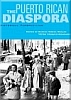
Migrating and building communities in the U.S.A.
From Hawai'i in 1900 to New England—the Puerto Rican diaspora grows in the
States...more than in Puerto Rico itself.
Don Jibaro: "I own this book. It makes me
churn."
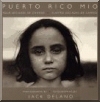
PR's
History
in Photos
The pages of this pictorial opus expresses the legacy, struggle, beauty,
misery, joy of Puerto Rico of days past. Delano saves the spirit of
Puerto Rico's past, once thought to be lost with faded memories. This is
a book to keep for oneself, it strenghtens one's soul. CLICK HERE
GREAT BOOK
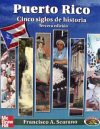
Cinco
Siglos
de Historia Book Review by Don Jíbaro About 10 yrs
ago I visited La Universidad de Puerto Rico. At their
bookstore I asked for the BEST book in Puerto Rican history
they had. "Cinco Siglos de Historia" inSpanish, by
Francisco Scarano from Fajardo now teaching at the Univ. of
Wiconsin-Madison)...I own it... I READ IT, loved it, now
my brother in law asks me "What's good in PR Hist? "HEY,
LUIS... DON'T LET THE PRICE FOOL YOU, there's none BETTER,
in real Academic SPANISH" Read for yourself
►GO
HERE










 Today we kill the words in the English language... which
is nothing new. We kill the words differently than our
ancestors did. Shakespeare spins within his grave.
Killing words is considerably at variance with the
ways they are spelled and often even more so with the
ways we think we are saying them. We may believe we say
"later" but in fact we say "lader. " We may think we say
"ladies," but it's more probably "laties" or even, in
the middle of a busy sentence, "lays." Handbag comes out
as "hambag. " We think we say "butter," but it's really
"budder" or "buddah" or even "bu'r. " We see wash, but
say "worsh. " We think we say "granted," but really say
"grannid." No one says "looked." It's "lookt." "I'll
just get her" becomes "aldges gedder. "
Today we kill the words in the English language... which
is nothing new. We kill the words differently than our
ancestors did. Shakespeare spins within his grave.
Killing words is considerably at variance with the
ways they are spelled and often even more so with the
ways we think we are saying them. We may believe we say
"later" but in fact we say "lader. " We may think we say
"ladies," but it's more probably "laties" or even, in
the middle of a busy sentence, "lays." Handbag comes out
as "hambag. " We think we say "butter," but it's really
"budder" or "buddah" or even "bu'r. " We see wash, but
say "worsh. " We think we say "granted," but really say
"grannid." No one says "looked." It's "lookt." "I'll
just get her" becomes "aldges gedder. "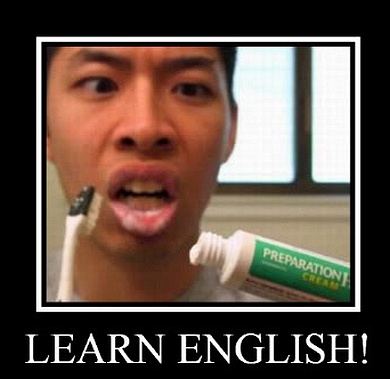
 All
of this is by way of coming around to the somewhat
paradoxical observation that we speak with remarkable
laxness and imprecision and yet manage to express
ourselves with wondrous subtlety --- and simply
breathtaking speed. In normal conversation we speak at a
rate of about 300 syllables a minute. To do this we
force air up through the larynx --- or supralaryngeal
vocal tract, to be technical about it --- and, by
variously pursing our lips and flapping our tongue
around in our mouth rather in the manner of a freshly
landed fish, we shape each passing puff of air into a
series of loosely differentiated plosives, fricatives,
gutturals, and other minor atmospheric disturbances.
All
of this is by way of coming around to the somewhat
paradoxical observation that we speak with remarkable
laxness and imprecision and yet manage to express
ourselves with wondrous subtlety --- and simply
breathtaking speed. In normal conversation we speak at a
rate of about 300 syllables a minute. To do this we
force air up through the larynx --- or supralaryngeal
vocal tract, to be technical about it --- and, by
variously pursing our lips and flapping our tongue
around in our mouth rather in the manner of a freshly
landed fish, we shape each passing puff of air into a
series of loosely differentiated plosives, fricatives,
gutturals, and other minor atmospheric disturbances.





 Book
Book