The Puerto Rican
Diaspora (book) Migrating and building communities in the U.S.A.
From Hawai'i in 1900 to New England—the Puerto Rican diaspora grows in the
States...more than in Puerto Rico itself.
Don Jibaro: "I own this book. It makes me churn.
A ROSE BY ANY OTHER NAME DEPT. The Trouble With The Áccents by Don Jibaro Barbanegra
Having accents on the letters of my name has always been a problem. Some
computers treat "á" different than "a" because they ARE different, but for
most people, they're the same, namely for newspaper editors, bank tellers, clerks
and other myriad of good, honest and decent civil servants.
Before the advent of computers, I remember buying a special typewriter that had
the accents on special keys along the keyboard. Whenever I had to type an
accented word, I had to go outta my way and hit the particular special key. It was
inconvenient but the words looked "prettier" after I typed them. It was a good
thing. Today, typewriters are almost non-existent.
Imagine, then, that your name is Aly Colón and the editors neglect the punctuation and you
become "Aly Colon" ...for worse. Down for a colonoscopy you go!
But
Colón is a real person, a Puerto Rican who writes his name with an accent over the second "o"
just like all Puerto Ricans do if your name has accents... anywhere. Colón says:
"My father told me that I had a family name, and that that was a name I was to
grow up and honor and one of the important elements of honoring
that name was spelling it right." Of course, all this bru-ha-ha happens
primarily in the USA where accented words are not part of usual literature.
Colón laughs (or cries) as editors can not (or would not) distinguish his surname from the less than elegant body part
on your behind... or the two dots (:) one over the other one used for punctuation
to exemplify that something is coming next.
If his editors said
they couldn't or wouldn't add the slash to his byline, Colon began adding it by
hand before the paper went to press. ¡Ay, pobre Coloncito!
Most people with an accent in their name don't have the option of knocking on
the door of the local copy editor, nor do they have Colón's passion on the
issue. But more and more Hispanics are coming to the USA and, with a decline in
newspaper sales due to the glorious Internet, editors are rethinking that it
might be a good idea to learn to type the doggone accents and tildes over the
"n" ...officially known as diacritical marks. Yes, they are a pain to add but
should be learned as an issue of punctuation accuracy, one of the basic tenets of
journalism.
The absence of accents can dramatically change the pronunciation and the meaning of a word.
The Spanish word Pena, without the tilde ~ over the "n," means "sorrow",
something nobody'd like associated with their name, Peña, a real surname (the word
means rock-cliff). The word for "year" without that squiggly tilde becomes anus, tu sa'e...
ano, el fondillo. ¡Ay, fó!
Most readers don't take the matter too seriously and usually think it's funny when
they see it wrong.
This reverberates the wilderness cry of other Hispanic newspaper readers when they say that seeing the accent marks
would be nice.
Some question why the use of accents on some French words such as
résumé
(yup, two accents) are
accepted but not on Spanish words. Advertisers, aiming to apease readers have
been quicker to make the change, whereas many could care less or they just
don't care.
Cartier's newest "La Doña" line of watches, created in honor of Mexican actress
Maria Felix, features the tilde over the "n," distinguishing the product from
the Spanish word for donut... "dona". So there!
"When you're persuading people, you want to eliminate any barriers to the
communication," said Carl Kravetz, chairman of the Association of Hispanic
Advertising Agencies. "If you're borrowing the word from another language
anyway, you might as well get it right."
"If you did choose to use accent marks, your staff would have to be
knowledgeable enough about when to use them," said St. Petersburg Times
executive editor John Schlander, explaining why his paper does not use them.
"Some people are going to be bilingual, but others aren't.
In recent years, the New York Times, Los Angeles Times, The Miami Herald and
other large newspapers have begun to add them, as have smaller papers, but they
are usually applied inconsistently and are far more likely to appear in the
style section than the news pages.
Many papers blame The Associated Press for going accentless. Their wire service's
2006 stylebook says accents shouldn't be used "because they cause garble in many
newspaper computers." A lame, cheapo, barata and no good excuse, eventhough some Internet browsers
don't "see" them unless you select a Western Character Encoding in the display
options. On Firefox, for example, go to VIEW... CHARACTER ENCODING... Western
(Windows - 1252)
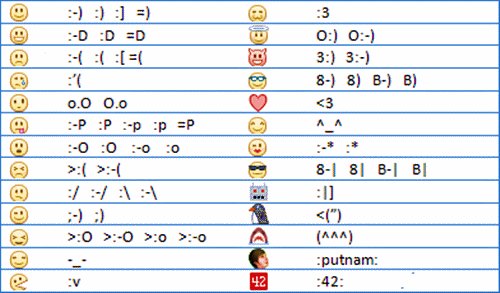
Facebook thingies
Yet the issue is far from closed at the AP, where senior editors are looking at
ways to insert accents in the names of individuals who prefer them. The wire
service has long transmitted accents on its non-English wires.
The technology issue is changing as more newspapers switch to computer software
that can handle the coding necessary to read the marks transmitted by AP.
Editorial software provider Atex Limited, which serves 50 small and medium
papers throughout the U.S. said all its systems can support accents. ¡Carámba!
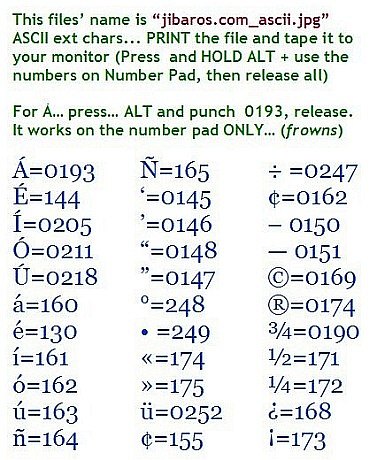
It was about time! I've been using them since my days with MS-DOS computers
back in the 1980s.
The issue migth be difficult for the international desk, which
has the most words to check and still gets much of its copy through e-mail and
other systems that may change the accent. Also, many Hispanics in Los Angeles
have lived several generations in the U.S. and no longer even use an accents.
They've given up. Still, for some purists like myself and for accuracy's sake, the trend is toward accents.
Don Jíbaro's Amendment
In order to bring my existence into conformity with a standard that is true
blue, I have corrected most of my spelling. Thanks for being so cordial and
polite by not throwing it in my face. After all, I am a jíbaro. Hallelujah!
Consequently, in my statement about some Internet
browsers not wanting to "see" the accents unless you select a Western Character
Encoding in the display options, I was referring to Mozilla Firefox. To correct
this, go to VIEW... CHARACTER ENCODING... Western (Windows - 1252) or Western
(ISO-8859-1). (Microsoft's Internet Explorer sees them just fine.)
Don't worry. Just as you, I don't know what the heck it means but I know that
it corrects the way the page displays accents.
Peace and Prosperity, Don Jíbaro Barbanegra
“Live in such a way that no one blames the rest of us
nor finds fault with our work.” --(2 Corinthians 6:3)







 The Trouble With The Áccents