The LORD is my light and my salvation; whom shall I fear? The LORD is the strength of my life; of whom shall I be afraid? --Psalms 27:1

CLICK HERE

Search Here  


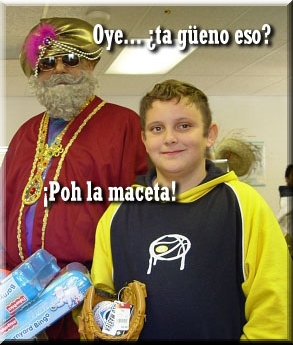
Don Jibaro's son Sammy, questions if Melchior has the "plátano stain" but not before he already had his X-Box secured. Sammy concludes: "I was born at night, but not last night."

Dia de Reyes: Defining Puerto Rican Culture
by Don Jibaro Barbanegra
n the early 1950s, I didn't know about Santa Clós in Bayamón, Puerto Rico, the town where I grew up. We had THREE KINGS!!! I would leave a shoebox by my bedside every Jan. 5, filled with grass. According to tradition, three kings would come to my house in the middle of the night and leave presents in it.
I , as many of the other Boricua kids, believed the camels would actually eat the grass.

There was much anxiety in the "barrio" the night of the 5th... and needless to say, we went to bed with much anticipation. What if I left my toes uncovered, too close to the edge of the bed and the camels chewed on them, or... what if they pooped on my floor… inside the box? Or worse... what if the Three Kings missed my house altogether? Ay, Bendito! The HORROR!!!

I, for one, never thought that the observance of Los Tres Reyes Magos, or three "magician" kings, would end. Even though I moved to the United States when I was 24, Santa Claus NEVER replaced the Three Kings. Even as the years have gone by, now that I am fifty plus years older, and somewhat immersed in the American culture, I have taught my children the wonderful tradition of Los Tres Reyes Magos. Even my wife and I put out our little boxes... kind of joining in the action.

So... let me give you a bit of background on this so important very part of Puertoricana...

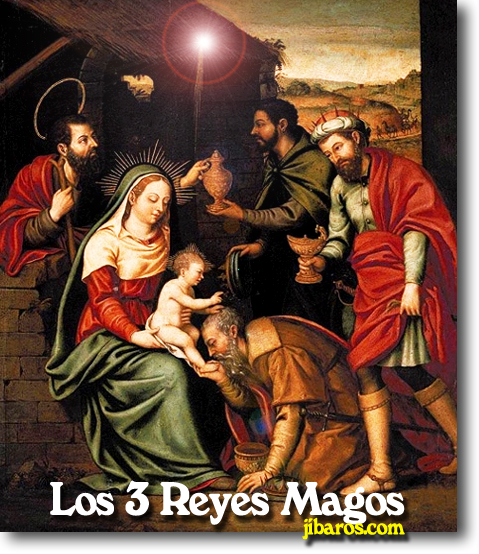
Yes, there are twelve days of Christmas and they begin on Christmas Day and end on January 6. The twelve days of Christmas end with the Feast of Epiphany also called "The Adoration of the Magi" or "The Manifestation of God." Celebrated on January 6, it is known as the day of the Three Kings (or wise men/magi): Gaspar, Melchor and Baltazar. According to a Bible story, these three kings saw, on the night when Christ was born, a bright star, followed it to Bethlehem and found there the Christchild and presented Him with gold, frankincense and myrrh.
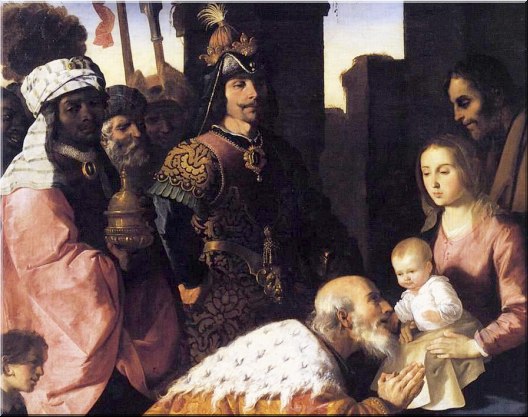
January 6, the last day of Christmas, comes with its own traditions, rituals and symbols. Carolers are going from house to house; in many homes the Christmas tree is taken down and in some areas is burned in a big bonfire. For the children this is an especially joyous occasion because, associated with taking down the tree goes the "plündern" (raiding) of the tree. The sweets, chocolate ornaments wrapped in foil or cookies, which have replaced the sugar plums, are the raiders' rewards.

The history of Christmas, (the festival of the nativity of Jesus Christ,) is intertwined with that of the Epiphany. The commemoration of the Baptism (also called the Day of Lights, i.e. the Illumination of Jesus) was also known as the birthday of Jesus, because he was believed to have been born then of the Virgin or reborn in baptism. In some records Christmas and Epiphany were referred to as the first and second nativity; the second being Christ's manifestation to the world.

“I never became so Americanized that I forgot where I came from,” I told a friend recently. “Inasmuch as my peers did not celebrate the same holiday (they did the "Santa" thing), it was not for me to abandon such a rich and rewarding custom.” I believe that as Puerto Ricans… "ausentes" living away from the Island, it is imperative that we revive the Three Kings holiday and other Puerto Rican traditions with our families. It’s just part of our roots.
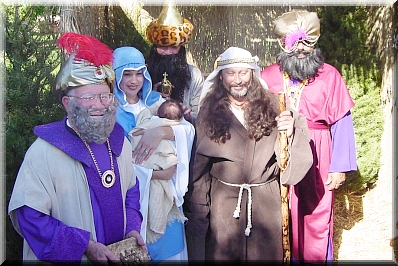
Like me, a growing number of Boricuas in Los Angeles and the nation are rediscovering their roots. There are, however, many Puerto Ricans in the USA who have never lived in Puerto Rico but hold fast to the traditions that their parents taught them as children... Some have dubbed these Boricuas “born again Latinos” — Boricuas who grew up in an English-speaking environment, who speak little or no Spanish and have reached over the "charco" to embrace their cultural heritage.

The amazing growth in the Latino population in America and the resurgence of many Puerto Rican actors, pop stars and other celebrities (who aren't ashamed to say... "I am Boricua"), have inspired many of the other more assimilated Latinos come to terms with their displaying of their heritage as cool. Celebrities who show Boricua pride, like Jennifer Lopez and Ricky Martin, have done a lot to inspire many who were otherwise apprehensive show that they are Puerto Ricans.

There appears to be a trend and thirst for Puerto Rican heritage and the Quest back to our Roots. In many communities Latinos in leadership have become more visible in the past decade. In Allentown, PA, they now make up a quarter of the population; in Bethlehem, PA (not Israel), 18 percent; and in Easton, 10 percent. Those who research and come to terms with their roots find it easier to display their heritage in public... and it's curious to notice that earlier Irish. Italian and German immigrants went through similar tugs-of-wars until finally coming to being and feeling accepted.

It is sometimes sad that Boricuas in the USA do not feel the need to fit in the USA Spectrum of Boricua Heritage. Many who come to my house find it curious that I have so much Puerto Rican art, curios and other paraphernalia on my walls... In contrast, many who are being educated about culture become more proud of who they are, allowing our language, family and traditions to become more important. This is evident by the amount of "cachibaches" that we bring when we visit Puerto Rico. Most of this education is simply learning Spanish and taking Latino Studies classes at local Community Colleges.

Still many Boricuas in the USA have relatives that speak Spanish, a language they do not understand or speak... from a country they know nothing or very little about. So make plans to spend a year or two in Puerto Rico to immerse yourself in your wonderful culture and language... then go into your grandparents’ house and speak to them in their native tongue. That is the best way to connect with them.

Since many JIBAROS growing up in middle class suburbs of America have blue eyes and blonde hair, they consider themselves "white", hang out always with the white crowd and live a "white" life. When one parent is white, they primarily connect with that side. Now they find out that it's time and want to rediscover their Puerto Rican side... wanting to strike a balance between his American side and Latin roots.

For many white Puerto Ricans, it becomes easy to blend in with American society. When parents moved to America from Puerto Rico, kids attended school with mostly white students. If kids grow tall and have a fair complexion, thanks to Anglo ancestry on one parent's side, it can become easy to get "lost" in the shuffle.

I remember meeting my Puerto Rican Pastor at a church where we once attended. He was raised in New York most of his life and the Spanish he spoke was good but "translated". So I told him one day: --“¿Que' jesto, Chico... M'chacho, you have to speak ‘con sabóo’, nene!” I immediately saw a big imaginary question mark pop up on top of his head.. I knew that unless he volunteered the information, many of his peers did not know he was Puerto Rican. As our friendship grew, he spoke “Puerto Rican” more and more… Now he sees me and says: “¡Oye, chico… ¿Qué jesto? ¡Bendito!”

YES, CLICK ME!As we grow older and get closer to that day where we shall leave this Earth, we come to terms with what we have done with our lives… most of what will be memories, AH! …And the certainty that we have run a good race and fought the good fight!

"Don forget about truth and mercy; tie them around your neck; write them upon the tablet of your heart; and you'll find favor and good understanding with both God and man." —Proverbs 3:3-4


CLICK ME Concord Picante 25th Anniversary Collection
 Less than $25. In 4 CD Boxed set, Mongo, Tito, Eddie and many others... Thick booklet included. This Concord is a must-have


!CLICK HERE
Cocina Criolla
by Carmen Aboy Valldejulli
This the standard on PR cooking. You must have this one.
 

"Jibaro Hasta El Hueso CD"


New Palmieri !!!


Puerto Rico Past and Present
by Fernandez,
Cueto y Mendez
408 pages

See LOW price


Stay informed... Subscribe to the Jibaros Newsletter

_____________________ The Bottom Line ______________________
“Live in such a _way that no one blames the rest of us  
nor finds fault with our work.” --(2 Corinthians 6:3)


JIBAROS
.COM © Copyright 2005 - This website all its contents and artwork is Copyright © by Orlando Vázquez, owner -  Jibaros.Com®, Jibaros.Net® All rights
reserved by the respective sources. Jibaros.Com does not accept any responsibility for the privacy policy of content or services provided by third party sites. U.S. Copyright Office, 101 Independence Ave. S.E. Washington, D.C. 20559-6000.